
Per the US Census, as of 2022 high level demographics about education are:
| Category | 2022 Data |
|---|---|
| Population | 331.4 million |
| K-12 enrollment | 57.9 million |
| College or Graduate School | 17.3 million |
| High School Graduates | 216.2 million |
| Non-High School Graduates | 26.3 million |
| Vocational School | 268.9 thousand |
| Bachelor’s degree or Higher Attained | 36.8% |
Working through the numbers, 84% of adults have a high-school degree, while 10% do not. Post high-school education (or certification) calculates to 98% in college and 2% in trade school.
The split of public school matriculants compared to private school matriculants for colleges and universities is 81% and 19%, respectively.
| Tuition | Tuition + Living Expenses | |
|---|---|---|
| 2-year, in district | $3,598 | $17,439 |
| Public, in-state | $9,750 | $27,146 |
| Public, out of state | $28,400 | $45,708 |
| Private | $38,421 | $56,628 |
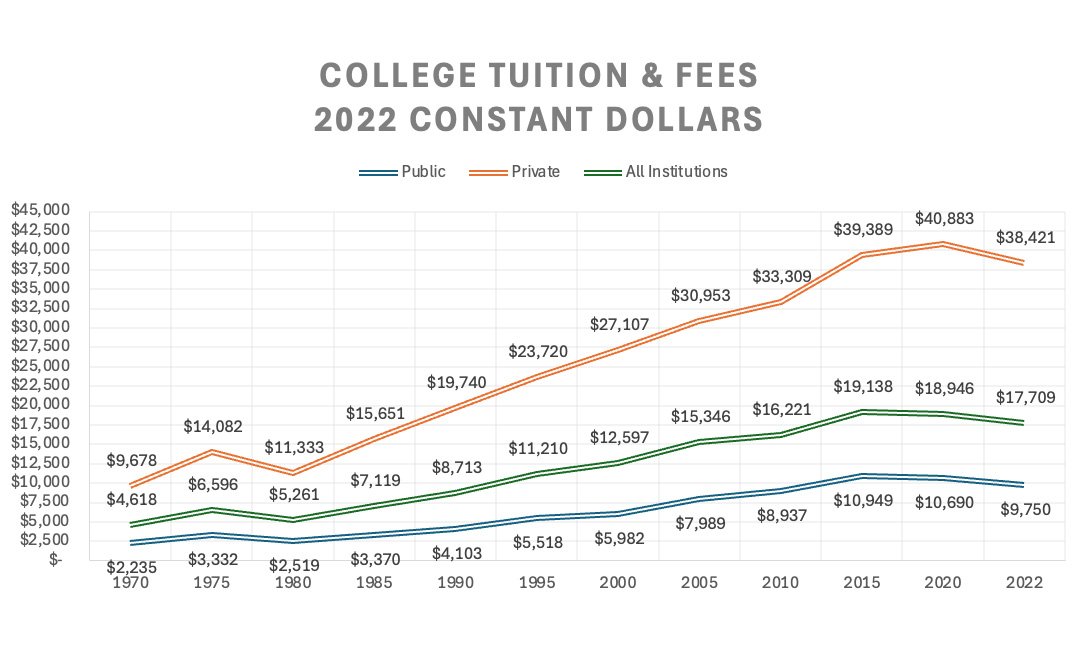
Living expenses do not include interest, lost wages, or other opportunity costs. It includes room, board, travel, supplies, and testing costs.
In 1963, full year tuition at a public school was $243. That amount would be about $2,500 in inflation adjusted dollars, compared to tuition being $9,750 in-state or $28,400 out-of-state. In other words, education costs have risen by 2.3% more than inflation per year.
Approximately 85% of undergraduate students borrow money for college. The average federal student loan balance tops $38,000. The typical repayment period ranges from 10 to 30 years.
It is fair to say the cost to attend college has risen significantly, possibly outpacing the gains in benefits.

K-12 Education History
The history of schooling in the United States is fascinating. In the Northeast, prior to independence, Puritans embraced education to enable children to read the Bible. Over 40% of Harvard’s (founded in 1636) early graduates went on to be ministers. The colony of Massachusetts made education compulsory in 1642.
Over the next 300 years, different regions had different standards, funding, and objectives regarding curriculum, gender, race, religion, and class. The level of training required of teachers was uneven. At different times, school leaders emphasized learning the classics, vocations, industrial work, agricultural science, religious instruction, military tactics, or even high-class socialization. In other posts, we will visit historical inflection points in education.
Today, education is funded and controlled on a local level for K-12; there is growing pressure to consider home schooling or charter schools instead of public education. With American college being so expensive, many are considering other options – such as trade school or attending University abroad. A fair question to consider is whether college is altogether necessary or if it offers the same payoff. Either way, if you plan on giving your child the option, then you must plan on ways to fund the investment.